Inside the Korean Cultural Centre Nigeria: Where Two Cultures Wear the Same Kind of Mask
There are moments when another culture doesn’t feel unfamiliar at all and feels like remembering something you already know. That was the feeling I had while standing in front of a wall of traditional Korean masks at the Korean Cultural Centre Nigeria. I lingered longer than I expected. Their carved expressions seemed to suggest that once someone wore them, they ceased to be entirely themselves. And somehow, instead of feeling distant, the idea reminded me of home.
On the second floor of the Rivers State Building in Abuja’s Central Business District sits the Korean Cultural Centre Nigeria (KCCN), a cultural space that has spent more than a decade introducing Korean culture to Nigerians while creating opportunities for wider African audiences to discover unexpected connections between Korean traditions and their own. What I found there, however, wasn’t just Korea. It was an unexpected meeting point between traditions that developed independently yet arrived at remarkably similar ideas.
Established in May 2010 by South Korea’s Ministry of Culture, Sports and Tourism and operated through the Korean Culture and Information Service, the centre was created with a simple mandate that is to introduce Korea to Nigeria while encouraging cultural exchange in both directions.
Step inside and the centre works hard to fulfil that mission. There is a library stocked with Korean literature, history books and films, the kind of place where a first-time visitor can lose track of time. Korean language classes run from beginner to advanced levels. A Taekwondo dojo has become one of the spaces helping to nurture Nigeria’s martial arts community.
Along one wall, visitors leave printed photographs and handwritten reflections after cultural events, creating a living archive of the people who have passed through its doors. Several times each year, the centre also hosts its K-Heritage Festival, where Korean performers introduce Nigerians to traditional fan dances and the janggu, the distinctive hourglass-shaped drum that has long been central to Korean folk music.
Yet for many visitors, the detail that leaves the strongest impression is not the language classes or the performances.
It is the masks.
The Wall of Faces
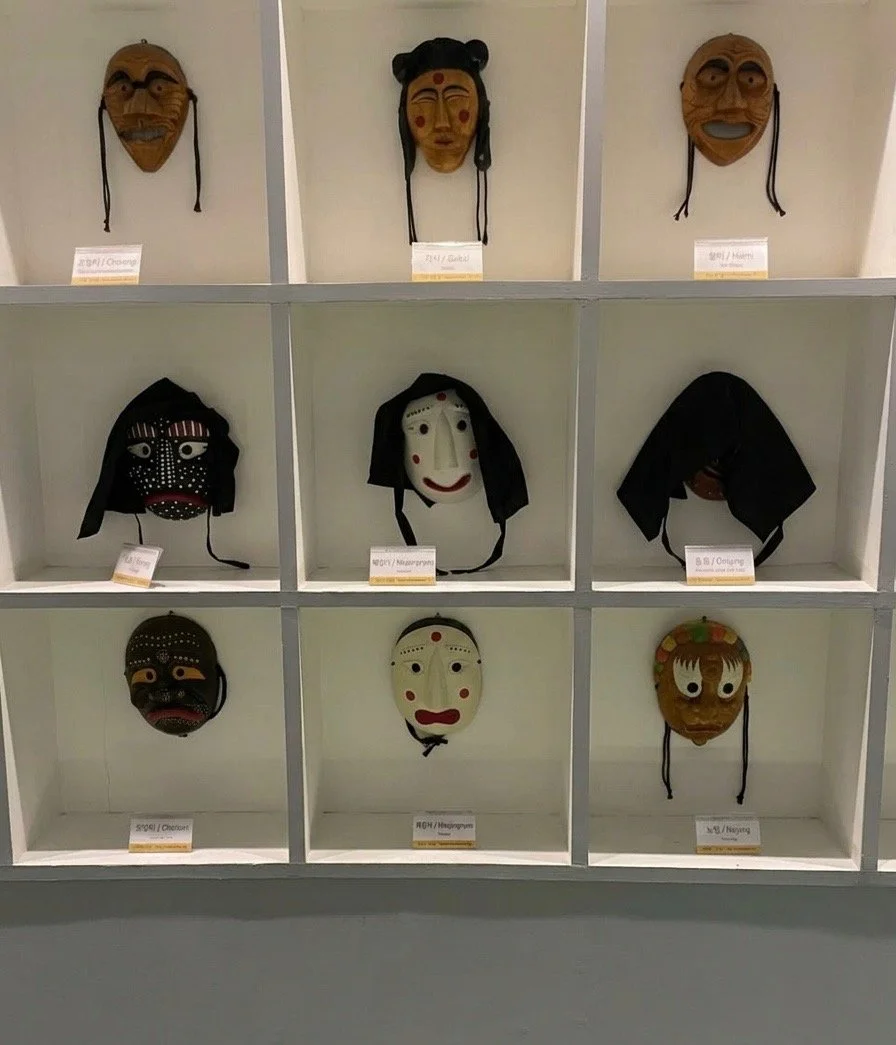
Traditional Korean tal masks displayed at the Korean Cultural Centre Nigeria, where visitors encounter a centuries-old art form rooted in performance and identity.
Among the centre’s exhibitions has been one titled “K-pop Meets Korean Traditional Music,” where visitors are invited to paint their own version of the tal, the traditional Korean mask. At first glance, it appears to be a light-hearted activity designed for schoolchildren and first-time visitors. In reality, it introduces visitors to an artistic tradition that feels surprisingly familiar once its history is understood.
In Korea, tal masks are central to talchum, a centuries-old masked dance drama recognised by UNESCO as Intangible Cultural Heritage in 2022. Although the tradition dates back to at least the Three Kingdoms period, it flourished during the Joseon Dynasty. Performers wear brightly carved wooden masks representing monks, aristocrats, servants, fools, demons and deities, transforming themselves into entirely different identities.
Even the Korean word tal carries a double meaning. Besides referring to a mask, it is also associated with trouble or misfortune, reflecting an old belief that masks could absorb negative energy and therefore had to be treated with respect.
But talchum was never simply entertainment.
In villages such as Hahoe, mask dances formed part of sacred rituals performed to honour local deities and pray for peace, prosperity and protection. Elsewhere, the same performances became remarkably subversive. Behind carved wooden faces, ordinary people mocked corrupt monks, greedy nobles and self-important scholars before audiences that often included those very elites. Satire disguised as festival became one of the few ways ordinary people could challenge power publicly.
Across Africa, the Idea Feels Familiar
Travel across continents, and the logic feels remarkably familiar. Across Africa, masks have long occupied a place beyond performance. From the Yoruba masquerades of Nigeria to the Dogon traditions of Mali, the Chokwe of Angola and the Democratic Republic of Congo, and the Punu masks of Gabon, carved faces have served as vessels for ancestors, spiritual forces, moral instruction and communal memory.
Within Yoruba culture, the Egungun masquerade remains one of West Africa’s most significant ritual traditions. Wrapped in elaborately layered costumes passed down through generations, masked performers are not believed to be portraying ancestors. During the performance, they are understood to embody them.
The word Egungun itself is rooted in the idea of ancestral spirits returning to walk among the living, blessing descendants, correcting behaviour and reinforcing the enduring relationship between families and those who came before them.
Alongside Egungun stands Gelede, another Yoruba masquerade tradition that honours the spiritual authority of women, particularly mothers, elder women and female ancestors. Through elaborate carved headdresses, music and dance, Gelede performances teach lessons about patience, responsibility, harmony and communal life.
Like talchum, they use performance to communicate truths that might otherwise be difficult to express directly. Placed beside one another, the parallels are very much striking.
Across Korea and many African societies, communities independently arrived at the idea that a carved wooden face could become a vessel for something greater than the individual wearing it, whether a spirit, an ancestor, a deity or a moral lesson too powerful to communicate through ordinary conversation.
Both traditions regard masks as sacred objects deserving careful handling beyond the performance itself. Both surround those masks with music, dance and audience participation, turning performance into a communal experience rather than individual theatre.
And in both cultures, transformation through the mask became more than a spiritual act. It also became a socially accepted way of speaking uncomfortable truths about authority, morality and community.
Why a Cultural Centre Is the Right Place to Notice This
It would be easy to assume the Korean Cultural Centre Nigeria exists simply to promote K-pop, Korean dramas and contemporary Korean culture. Those attractions certainly bring many young Nigerians and Africans through its doors. But the centre’s deeper significance lies elsewhere.
It creates opportunities for unexpected conversations between cultures that developed thousands of kilometres apart and through entirely different histories, yet often arrived at remarkably similar ways of understanding identity, memory and belonging. Masks are only one example. Korea’s janggu drumming invites comparisons with Africa’s own rich percussion traditions, from the talking drums of West Africa to the ceremonial rhythms that accompany rituals and festivals across the continent.
The reverence both societies show towards ancestors also reveals another shared instinct that the belief that those who came before us are not entirely absent, but remain present in memory, ritual and community. The Korean Cultural Centre Nigeria was established to introduce Korean culture to Nigerians. Perhaps one of its greatest achievements is something less intentional.
It allows African visitors to discover that some of the traditions they consider uniquely their also reveals unexpected connections on the opposite side of the world. Not because one culture borrowed from the other, but because human societies, separated by oceans and centuries, sometimes arrive at remarkably similar ways of explaining identity, memory, power and belonging.
Standing before those masks, I expected to encounter something unfamiliar. Instead, I found a reminder that cultures often speak to one another long before people ever do.