There Is Hope for Nigeria Because We Are Still Talking About It: Reflections from the Gatefield Caustival Exhibition
There is still hope because this conversation is happening.
At a time when insecurity continues to worsen and concerns about Nigeria’s political future grow louder, it can feel easy to lose hope. Every day seems to bring another headline, another crisis, another reason to believe that things are beyond repair. And within all of this, there is us.
Young Nigerians, frustrated, exhausted, and often quietly hoping that something or someone will somehow rescue the country. But giving up is not a neutral decision. It is a choice with consequences. I left this year’s Gatefield Caustival thinking about that.
The festival’s theme, “We Decide,” could not have been more timely. Through art, film and conversation, the festival explored civic engagement, social justice and the role ordinary people play in shaping society.
What struck me most was that the exhibition was not interested in offering easy answers. Instead, it asked a much more uncomfortable question:
What do We Decide to do Now?
Curated by Theo Allanso and Faith Dagbue, the exhibition was intentionally designed as a journey through four rooms, each inviting visitors into a different stage of reflection. As Dagbue explained, the idea was simple: before we can decide where we are going, we first have to understand where we are.
That journey begins with an assessment of our present reality. One of the first works visitors encounter is Kelechi Orode Chukwueku Aber’s How Much?, an installation that confronts one of Nigeria’s most normalised political realities: vote buying.
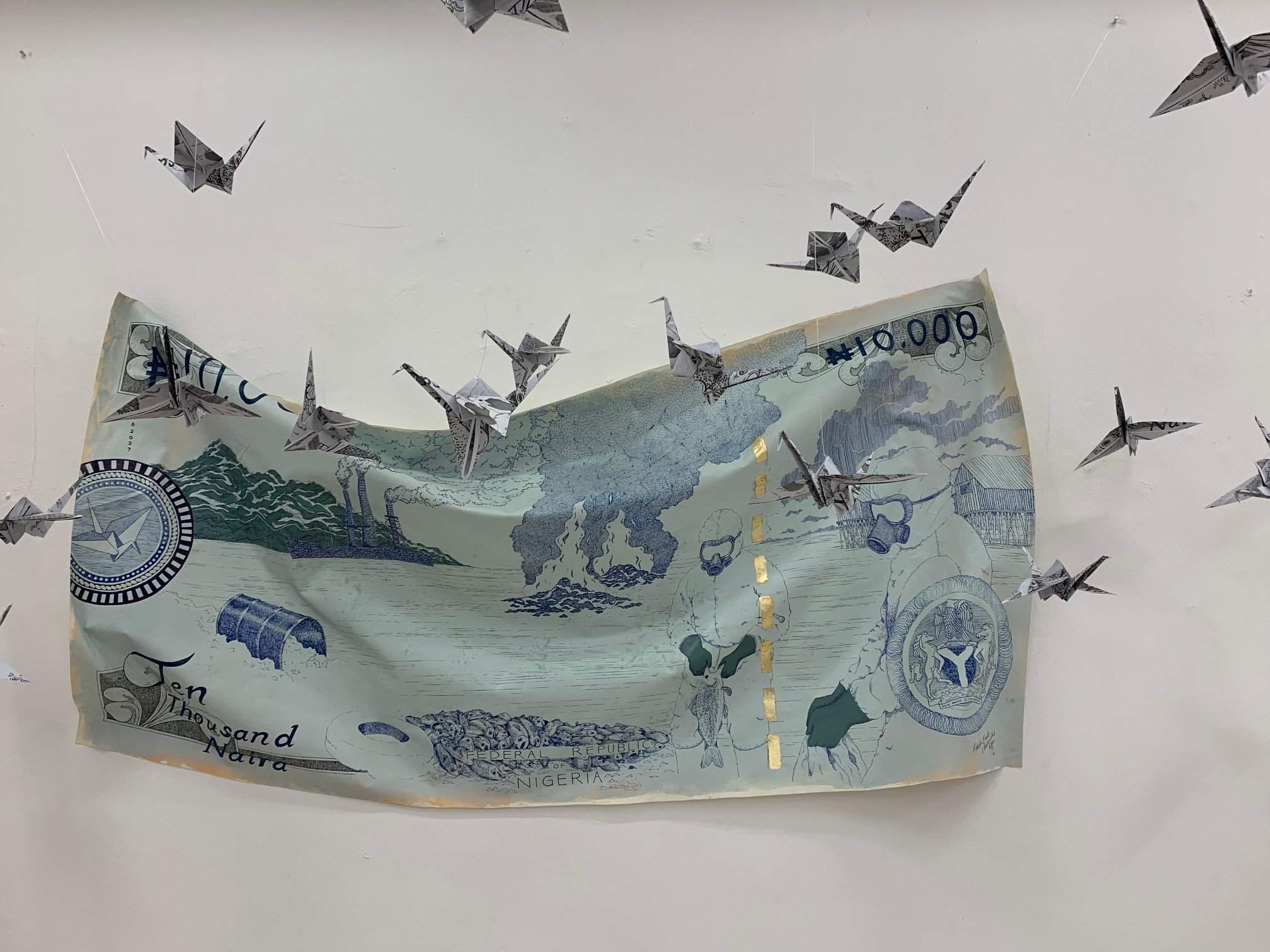
Kelechi Orode Chukwueku Aber’s How Much?
It challenges viewers to think about vote buying and the ways we may be complicit in our own political failures. The work asks a difficult question: What is our price for tolerating bad governance, and do we truly believe it is worth it?
At first glance, the work resembles redesigned Nigerian currency. However, on a closer look, familiar images of prosperity have been transformed into scenes of environmental degradation and neglect. On the note, fishermen who once pulled giant catfish from a river have been replaced by figures in hazmat suits dragging rubbish and dead fish from polluted waters. The contrast is quite unsettling.
“The piece is titled How Much? because I’m asking people how much their vote is worth,” Aber shared. “If someone gives you ₦50,000, how far does that ₦50,000 really take you compared to what the country continues to lose?”
Suspended above the work are delicate paper cranes, inspired by the Japanese tradition that folding one thousand cranes represents a wish. Here, these paper notes become a quiet reminder that collective action carries power and that citizens can choose to collectively sell their votes or collectively vote with intention.
What I appreciated the most was that the work did not attempt to lecture its audience. Instead, it trusted us to sit with the question ourselves Passing through a sheer curtain, visitors enter the second room, home to the Archive of the Nigerian Left, curated by Ibukun Omole alongside Maryam Ahmad and Saeed Hussaini. This was one of the most fascinating parts of the exhibition for me. Growing up, history often felt like a list of presidents, military rulers and major political events. However, this room offered something entirely different. Through letters, protest posters, publications and archival documents, it shifted the focus towards students, activists, trade unions, civic organisations and ordinary Nigerians who refused to remain silent.
The materials on display tell stories that are remarkably familiar. Many of the issues people organised around decades ago such as public accountability, transportation, economic hardship and social justice still remain unresolved today.
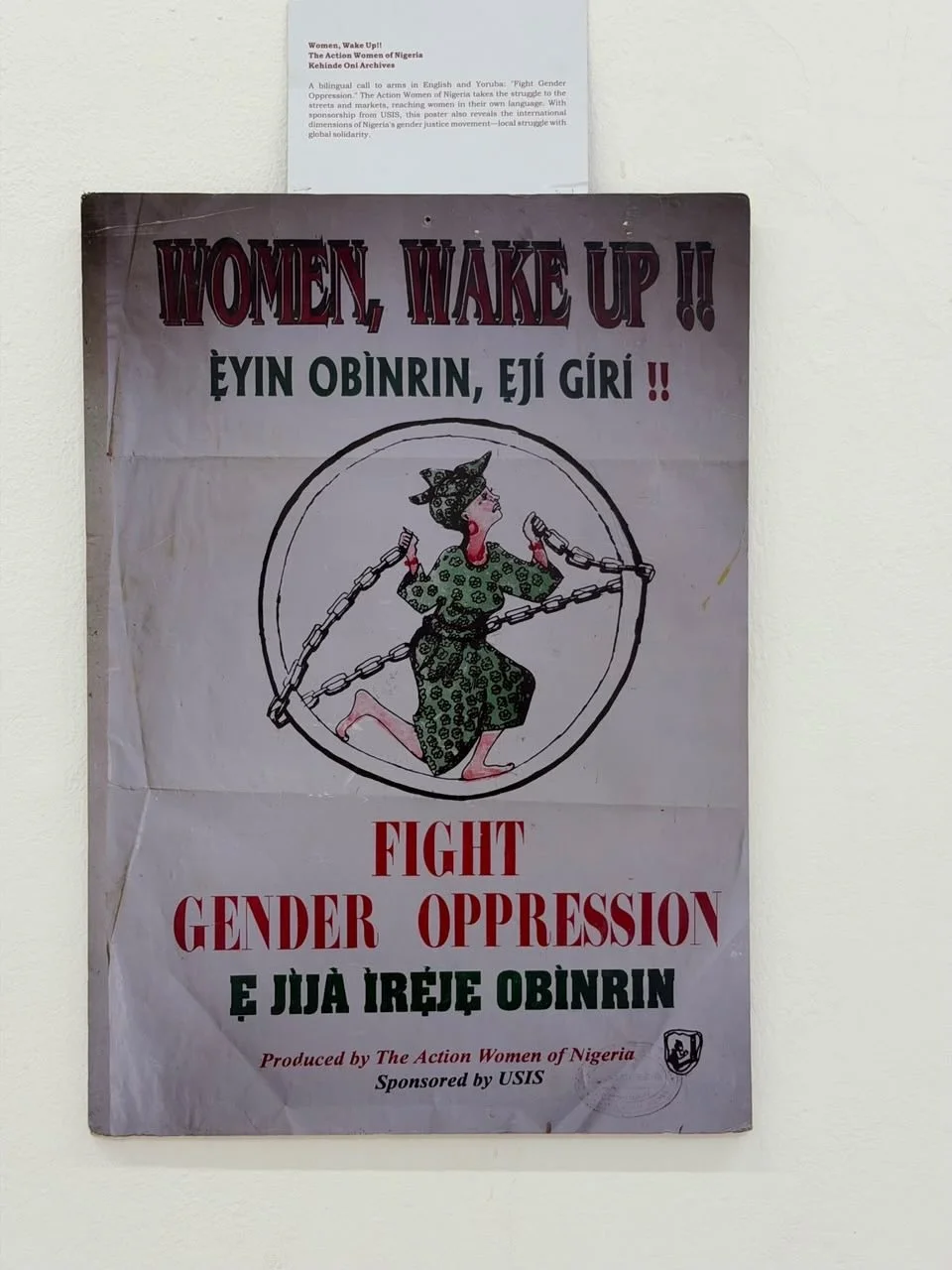
From the Archive of the Nigerian left, curated by Ibukun Omole, Maryam Ahmad and Sa’eed Hussaini
“The history we are are building is rooted in ordinary Nigerians,” Omole explained. “We want people to understand that democracy is not an event. Democracy is a process.”
His words transformed the room from an archive into something much more urgent.
The exhibition was no longer simply asking us to remember history. It was asking us to recognise ourselves within it.
More than anything, this room reminded me that people have always spoken up.
And perhaps that is where hope comes from. During my conversation with Faith Dagbue, she reflected on a line from Nigeria’s former national anthem: The labour of our heroes past shall never be in vain. She shared a thought that has stayed with me ever since. “The labours of our heroes past are actually not in vain,” she said. “They compound.” Even when it feels like the perfect time to lose faith, the labour of those who came before us has not been in vain. We are still discussing their ideas. We are still learning from their actions. Their not been in vain. We are still discussing their ideas. We are still learning from their actions. Their efforts have accumulated over time, and now the responsibility rests with us.
The exhibition’s third room turns that realisation into a challenge. Now that you know change is possible, what are you going to do about it? Mustapha Musa’s The Game We Play presents a chessboard shaped like Nigeria. At its centre stands a pawn casting the shadow of a king.
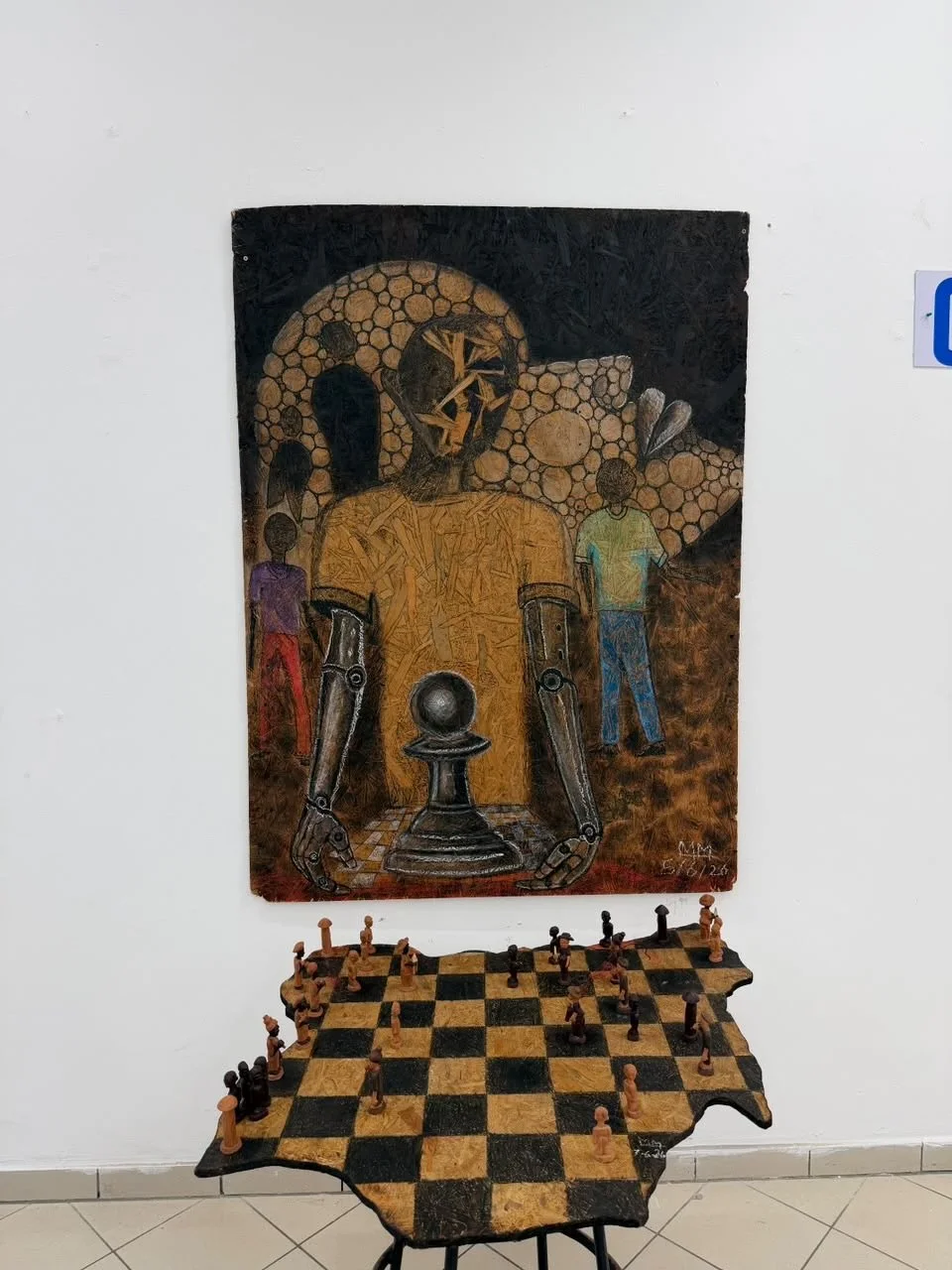
Mustapha Musa’s The Game We Play
“The politicians use us as pawns,” Musa told me. “But we are actually the strongest pieces because we can move.”
Running through the work are traces of blood, reflecting the violence and insecurity affecting many parts of the country. Growing up in Northern Nigeria, Musa explained that he has witnessed these realities firsthand. Whether we participate or withdraw, he argues, we are already part of the game.
Political disengagement is not the absence of a decision. It is a decision in itself. Those who benefit from public apathy are counting on citizens to remain passive pieces in a game they believe they cannot influence. The real question becomes whether we continue seeing ourselves as pawns, or finally recognise the power we have always possessed. The final room, dedicated to interrogation and reflection, feels like the conclusion of the exhibition’s journey.
If the previous rooms ask us to understand and act, this space asks us to pause. What decision are we making and why?
At its very centre is Imran Tilde’s reconstruction of the back of a Nigerian truck, assembled almost entirely from reclaimed materials such as worn tyres, discarded brake lights, scraps of fabric and recycled wood.
Truck drivers often use the backs of their vehicles as moving canvases, carrying messages across the country. Tilde imagined what such a truck might say if it were speaking about democracy.
Across the installation appears the Hausa phrase Kuskuren ka Malamin ka meaning your mistake is your teacher.
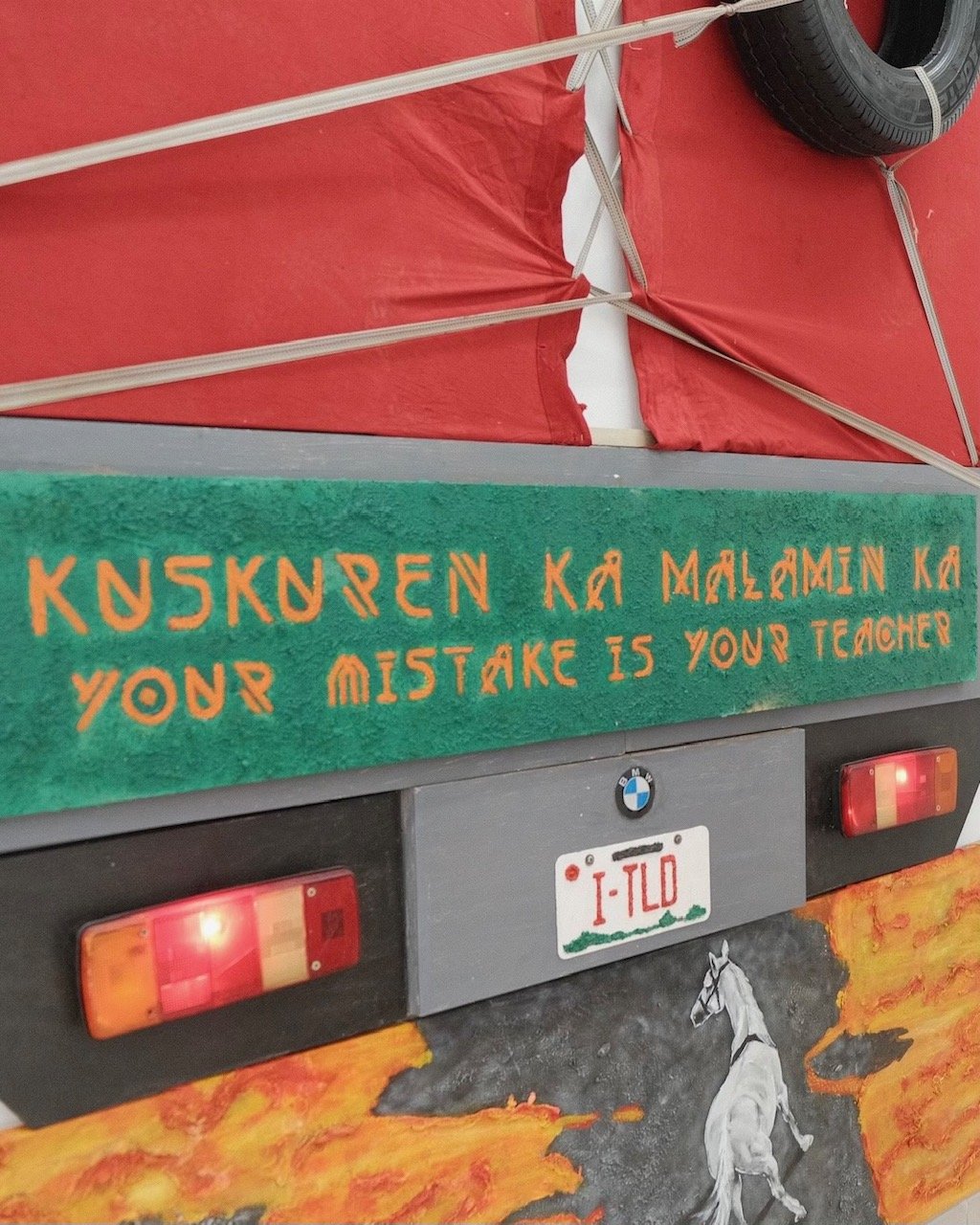
Imran Tilde’s Kuskuren ka, malamin ka
“Democracy offers us the chance to learn from our mistakes,” Tilde explained. “Every four years we have the opportunity to change our decision.” Standing before the work, I could not help thinking that the exhibition was quietly reminding us that we are the drivers of our own future.
The horse changing direction, the recycled materials and the proverb all point towards the same idea. Mistakes do not have to define us. Our mistakes can teach us. The mistakes of our leaders can teach us. The mistakes of previous generations can teach us. Just as a driver chooses which road to take, we decide what direction comes next.
Nearby, Jessica Louis’ We Decide reinforces that message.
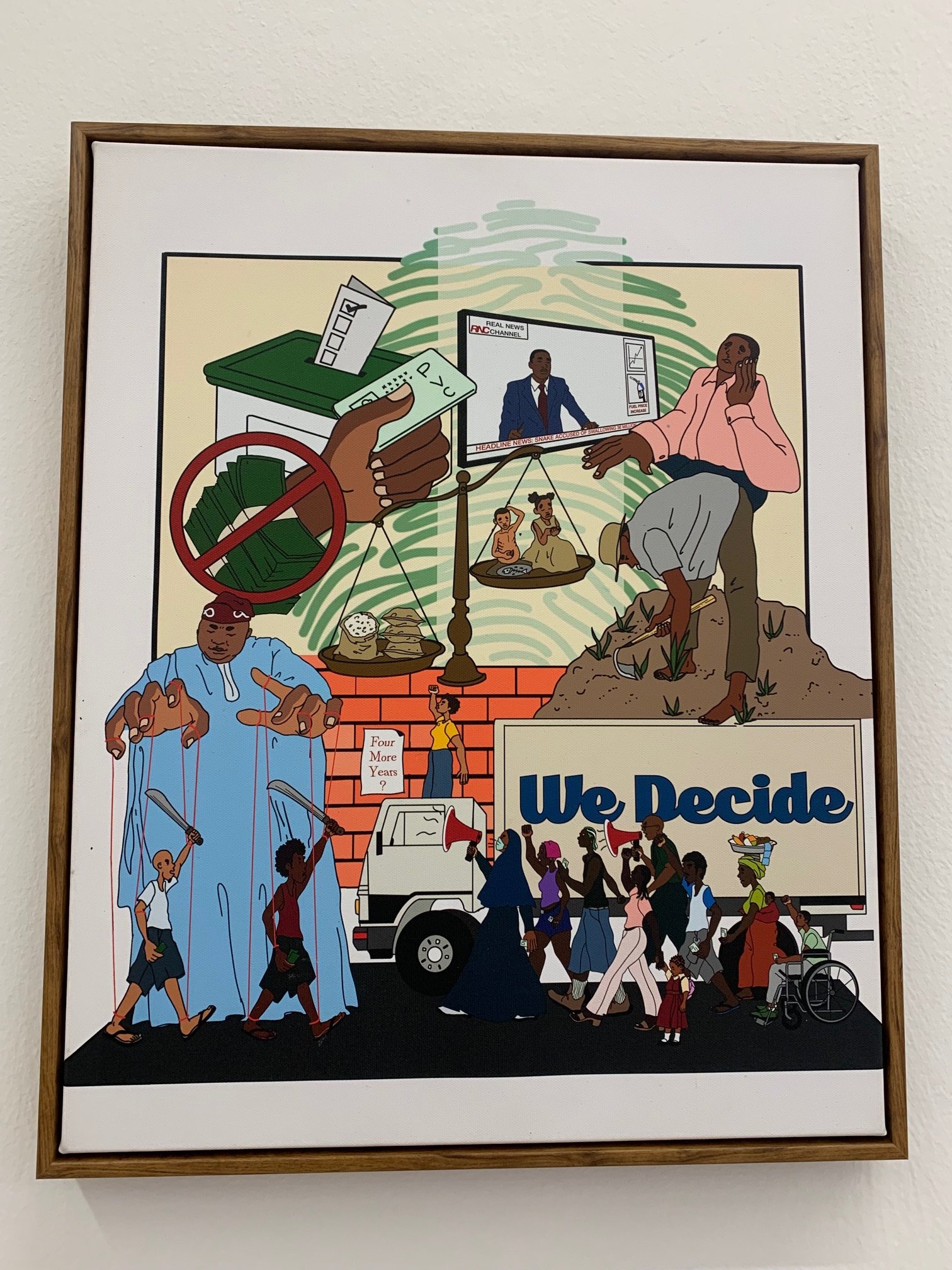
Jessica Louis’ We Decide
Layered with images of election violence, agriculture, food insecurity, protest and childhood, the work feels crowded in the same way Nigeria’s realities often do. “I wanted to put in front of us what our reality actually looks like,” Louis told me. “These are the consequences of our choices.”
Yet beneath the frustration lies something remarkably hopeful. “Our votes matter,” she said. “If they didn’t matter, people wouldn’t go to such lengths to influence them.” When I asked her what she hoped people would take away from the work, her answer stayed with me long after our conversation ended. “You don’t stop fighting just because the ship is sinking. You keep fighting.”
That conversation changed the way I thought about hope. Perhaps hope is not something we are waiting to find. Perhaps hope is already here. It exists in the conversations. It exists in the difficult questions. It exists in artists who continue making work that challenges us. It exists in curators who create spaces for dialogue. It exists in ordinary citizens who still believe that participation matters.
That is what I took away from Gatefield Caustival. Different artists. Different voices. Different perspectives. Yet every one of them was responding to the same question:
What do We do Now?
The exhibition does not promise that things will magically improve. Instead, it reminds us that the future is shaped by participation. There is still hope for Nigeria because people are still talking. And now, as the exhibition repeatedly reminds us, we get to decide what happens next.