Beyond the Canvas with Faith Gbadero
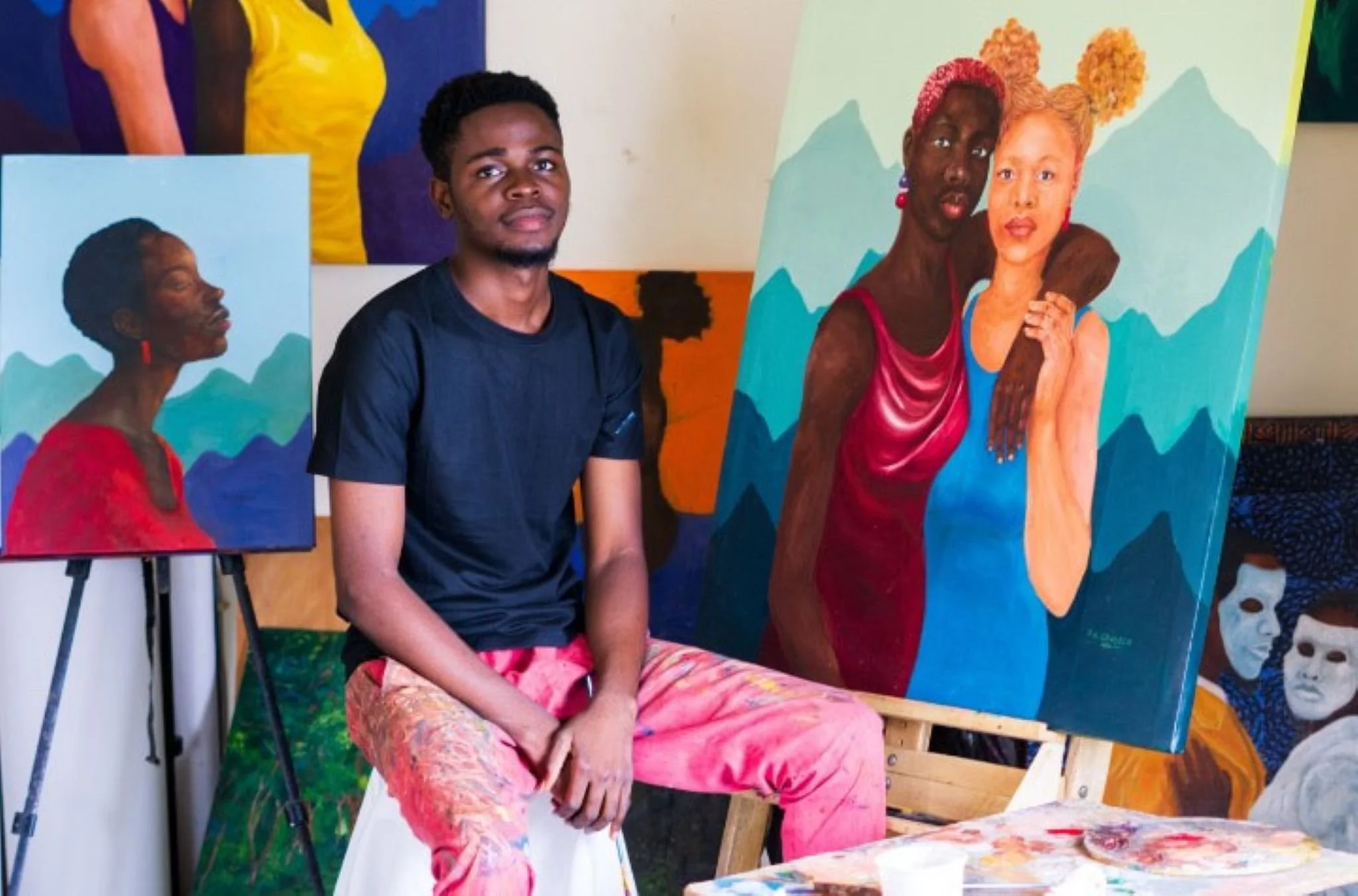
Faith is a visual artist from Oyo State who explores art not only in painting but also in experiences. His work has been featured in numerous exhibitions, including Oyo @50 Art Exhibition, “Yoruba ni mi” Art Exhibition, Made in Naija Art Exhibtion 3.0 and many more.
What's your Background? And how did You get Started?
I come from an African background, where identity, residence and spirituality are deeply woven into our everyday life. Growing up, I was constantly observing people, their strength, silence, struggles and becoming.
And that awareness shaped how I see humanity. Basically, my heart revolves around identity, humanity, resilience and becoming, so it didn't just start out as a hobby. It began as a way of processing identity and existence.
Then it became my language, a way to document the African experience, especially the inner life of the average African man and woman beyond different stereotypes, and what really pushed me to be a professional artist was me realizing that my work is not just about expression, but it's about representation.
I felt a kind of responsibility to tell our story, the African stories, what we pass through, what humanity entails, and cultural values with dignity, depth and emotional honesty.
Your Language, the things that You do Daily, what is Your Style, form Colors.
Figurative artist. And I use, basically, I use acrylic colors. I use oil colors, and oftentimes I use charcoal pencils and pastel. using acrylic on canvas and using acrylic and oil paint on canvas to explore African identity, resilience and becoming my composition, particularly my background, are intentionally minimal, allowing my subject, like giving room for my subject to command that emotional presence in the space.
And what's Your Inspiration throughout Your Expression and Whole Experience?
Over time, like I said earlier, I've seen art to be a medium of expression, a medium to pass across a message into the bar for people to see, for the public to see. And my inspiration comes primarily from lived experiences, both using my life and the lives of people and how we relate to each other.
I solely believe that humanity is about loving each other, loving yourself, loving each other and loving people in your society. I believe that the existence of a society does not rely on only one person but on the general public, the people that are living in that society. I'm inspired by the white strength of we, the African people, our resilience, how it goes unnoticed, and the emotional depth behind the everyday lives.
My journey has been one of growth and intentional refinement, from experimenting and discovering my voice to building a cohesive series of works, works that talk about my narrative as an artist, and every one of these particular stages has achieved my understanding of art, not just as being a tool of expression, but also being a responsibility to so it is not just about the aesthetics.
It is about the narrative, the idea, the impact, the representation, the message that you are passing across to people. And this has taught me to create with conviction and to stand confidently being authentic in my own story.
Your, Facial Figures are Apparent and Your Bio Points that You Explore Culture, Identity, Social Narratives and Human Connections. So how does Your Work Represent those Facial Figures Represent all those Three?
Talking about human connections actually. You know, there is a series of work that I worked on titled Love and bound. I love, love and bond. I don't know if you can see it that involves around albino and a black person.
So those that, those, those set of works, are the works that I created to pass a message to people. You know, there is this kind of stigmatization in our society that I think should be corrected or is not fair enough. You know, most of us, we are not chanced, or we are not given the opportunity to choose. There are some decisions that we are not being asked to make a choice from it is the choice of the color of your skin, the size of your leaves, or the shape of your nose or the size of your eye. So I'm using that work as a representation to pass across social.
Even though we have our differences, we all have to accept one another come together for the betterments or the progress of our society. And I think that is one thing that can make the society a better place.
You know, there are a lot of people that have some kind of imbalances in their lives, even talking about the people a leadership power, a leadership class, people in the leadership class, people that are more financially Okay, and people that are even not in balance in the structure of their body.
Some people that are not doing well. You know when we come together as a society, and you know when you are doing your thing as, let me say, somebody that is more privileged in the society, you have a good color.
All the parts of your body are complete, and you know you are doing well, you are looking beautiful, and you now looking down on those that are less privileged, people that have a kind of imbalance in their body or with their class. I think that is something that does not encourage them to get involved in some activities in the society.
And you know how a society can get better? When there is contribution and there is equal representation from everybody in that particular society. Yes, you make a really good point on that. And I even wanted to ask about the societal issues, but I think I already pointed that out.
What Challenges do you Face in Your Work?
Generally, as an artist, the challenges that I faced is, you know, this is Nigeria, and, you know, having a kind of recognition for the particular kind of message that you are passing across might be very challenging, particularly when you have not made a name yet in the art space, when you are still a growing artist, when you are still an imagined artist.
So and you know, getting your work to a bigger and the global space for sale can be very challenging, even though, with consistency, and let me say, you showing up every time, we overcome that. So that's one of the challenges that I face as an artist.
What's Your Perspective on the Creative Space in Africa?
I believe the African voice, the African creative voice, is very unique. And you know, the frontiers in the creative space. I've actually invested a lot in putting the African, the black voice in on the global stage. And I think what we can do as what we can do in this generation as artists is to raise the bar, raise the standard of what has been presented by our frontiers in the creative space and not really relent.
Always raising the bar. And you know not not abandoning or not ignoring our voice as an African, and not ignoring our identity. What makes us African? What makes us Black? I believe that there is a lot of influence of what our identity has to do on a global stage. So that's why I'm saying that concerning that.
What are Your Goals?
My goal as an artist is to go beyond recognition. And you know, I want my ads to actually get to a global stage where they're going to speak and make a good impact on people that come across them. Because I do the work, I believe that the work of an artist is that we have a message that is needed for people to feed on and for people to see, and that is what we pass across as artists. So I want my artwork to be a communication tool to make the society a better place, to make the world a better place.
Like I said, beyond the recognition. I want my artwork to really speak into the minds a lot of people and influence how we treat one another, how the how different countries continent treats one another, and you know, even how the leaders treat those, those people that are their followers, how the president treats is our citizens, how the governor treats its citizens, how our leaders treat their followers and how we citizens treat ourselves.
Final Thoughts?
One thing I would like to add is just that, you know, I also want my art to stand as a symbol of identity for the African and the BlackBlack community, you know, me being an African creative. I want my art to stand to be a symbol of the African identity passing across our cultural values, those things that we hold as virtues as the African people.