Tamani Art: How Ghaicha Aboubacar translates Tuareg Culture Into Abstract Art
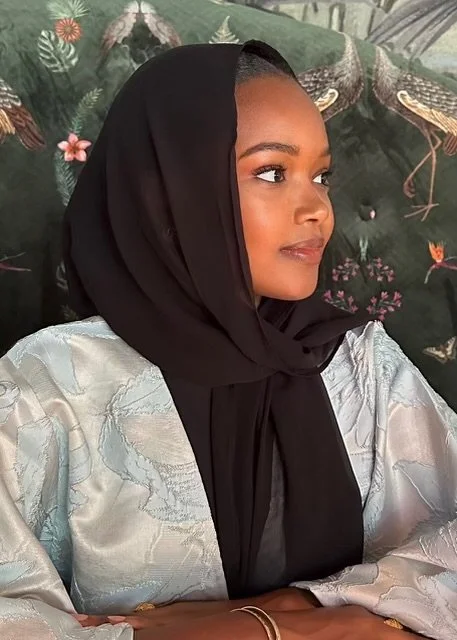
Ghaicha Aboubacar is a 25-year-old architect and artist from Niger whose work explores the intersection of emotion, environment and culture through abstract art. What began as a hobby at the age of fourteen slowly evolved into a creative practice that continued alongside her studies in architecture.
Deeply influenced by her Tuareg heritage, Ghaicha art draws inspiration from the colours, landscapes and traditions of the desert.
Rather than depicting people or scenes directly, she reinterprets cultural elements abstractly through textures, patterns, and colour palettes inspired by indigo turbans, desert dunes, and the vastness of the sky.
Please Introduce Yourself and Tell me how You got into Art
My name is Ghaicha. I'm a 25-year-old architect and artist. I got into art as early as 14 years old. I started at first as a hobby and then I got into architecture school, but I was still painting all throughout. It has always been a part of me and I never even thought of making it into a business or selling my paintings. People kept asking me but I didn't want to because I considered them as my babies. Architecture school definitely helped me with art in a particular way, and it made me want to expand and share it with the world.
You Paint about Emotions. What does that Mean to You?
I have this thing called synaesthesia. So when I feel things or even when I listen to music I see colours.
I thought it was normal, but apparently not. I see colours when I feel emotions and sometimes I feel textures as well. I've always wanted to express that. For example, I have a collection of paintings called “Elėhe”, which is a word in Tamasheq (a variation that means the cool breeze on a hot day. When I hear that word I see shades of blue and very light organic patterns, and I wanted to express that through painting.
How does Culture Influence Your Work?
My dad is Tuareg from Niger and I've always loved the colours of our traditional attires, like the indigo blue turban that the men wear.
Even our environments, the dunes, the beige sand are very beautiful to me. Tuareg people are nomads from the desert and because of that we really understand the concept of impermanence. They live knowing that they are temporary it doesn't stop them from being creative.
I've always felt like we were underrepresented, but at the same time I didn't know how to represent my culture.
Art became a way to do that. I'm not painting people or sceneries, but I'm reinterpreting them in my own abstract way.
You Studied Architecture. Has that Affected the Way You See the World and Express Yourself?
Oh yes, definitely. In architecture school they put a lot of emphasis on your relationship with the environment and the site you are working on. They didn't allow us to sketch project ideas without studying the site in person, going there, spending hours listening to the sound and experiencing everything. That changed the way I see space and environments, and it also changed the way I paint and imagine ideas.
For example, if I go to the ocean and I hear the different sounds, I hear the waves and I feel the breeze on my skin, all of that will really inspire me. I'm kind of like a sponge and I just explore whatever my environment has to offer me and then flesh out my ideas.
Do You Remember the Moment You Decided to Turn Your Art into a Brand?
Yes. A very dear friend of mine once gifted me a notebook with my mood boards about Tamani. I've always had Tamani as a dream for an eventual brand. I always had the name and mood boards in the back of my mind but didn't know what form it would take. When she gave me that notebook with everything inside it, I was so touched. That was really the beginning of everything.
Can you Walk me through the Inspiration Behind one of Your Recent Works?
One of my latest paintings is called “Tinariwen”, which means “empty space” in English. It's based on the vastness of the desert and what it represents. Just like the ocean, the desert is so vast that you can't see where it ends, and it reminds you of eternity.
I chose colours like beige as the base and indigo blue, referencing the turbans worn in our culture, the sky, and the connection between blue and spirituality. My paintings are usually half concepts that I've thought about beforehand and half pure intuition.
Would You say Your Spirituality Affects what You Paint?
Oh yes, totally. I was brought up Muslim, my parents introduced God more as a friend than someone who judges or condemns. I think the fact that I chose abstract art is linked to spirituality because spirituality is also abstract.
You can't touch it; it has no form. It's something that you feel. That's why I like painting things that aren't things, abstract and formless, because they evoke different feelings in everyone.
I have a painting that's called Transcendence and it's basically a circle with rays of light emanating from it and what inspired that painting is how God transcends all things, yet he knows us and we see him in everything.
What do You See for Your Brand moving Forward?
I would love to do an exhibition around a particular theme, whatever it may be. I’d also just simply love to paint more and keep painting more.
What has Creating Art Taught You about Yourself?
My art has taught me to be more patient with myself. It has taught me to be less of a perfectionist and to let go. I'm quite structured and organized, and a bit of a control freak. But with art that doesn't work. You have to surrender to the process.
With each canvas I learn to let go a bit more and go with the flow.