Through Bongani Morgan’s Lens
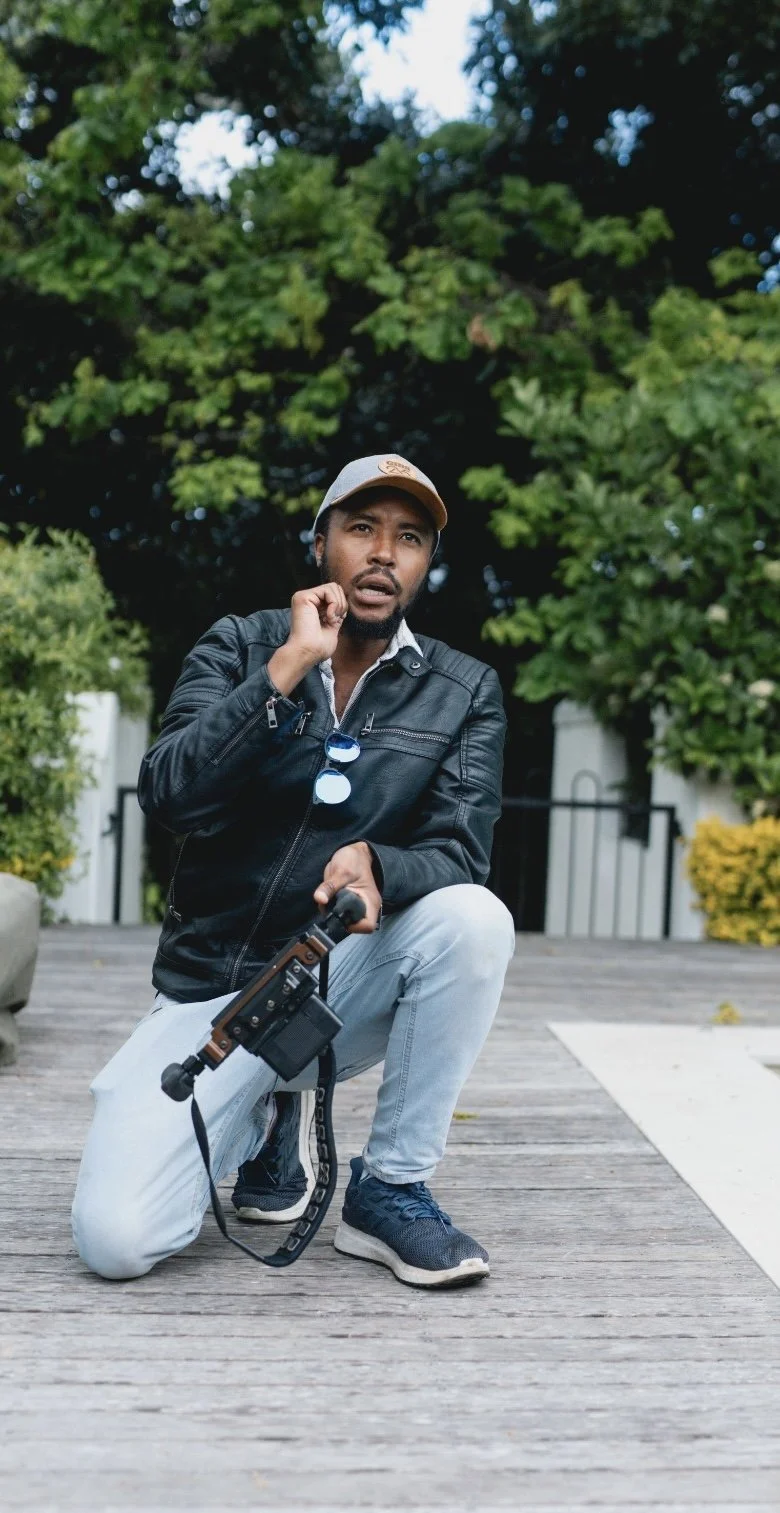
Bongani Morgan is an award-winning filmmaker from Johannesburg, South Africa. He specializes as writer and director. His work is characterized across different mediums as narrative-driven, resonant, authentic storytelling focusing on character. He's a versatile director with extensive experience in film, TV, commercials and digital production, specializing in New Media. His films have been streamed on Showmax, Mzansi Magic and SABC 1.
How would You Describe Yourself to Someone who is just Meeting You for the First Time?
I’m a storyteller before anything else.
Then you can get specific; I’m a filmmaker, a writer and director. Ultimately an artist who is really interested in people—in who they are beneath image. I’m drawn to truth, tension, contradiction and beauty, especially in places and people that are often overlooked.
I think I’m someone who moves between worlds quite naturally; commercial and cinematic, intimate, epic, emotional and strategic. So I care a lot about meaning and legacy. At my core, I’m trying to make honest work with emotional weight.
How would You Describe Your Artistic Process?
My artistic process usually starts with an emotional or philosophical impulse before it becomes a formal idea. Usually it’s catalysed by something that unsettles me.
I think it comes from thinking about tension — moral tension, emotional tension, historical tension. I’m learning that’s usually where the most compelling work lives. Ultimately, my process is about moving from instinct to precision.
What Motivates You ?
Honestly, it’s a mix of love, burden, obsession and responsibility. I love stories. I love cinema. I love what happens when something truthful is captured in a way that hits people in the chest.
But I’m also motivated by the fact that too many stories - especially from where I’m from, or about people like us - have either been ignored, flattened, appropriated, or poorly told. So part of what drives me is the need to tell things properly. With dignity, complexity scale, all punctuated with emotional intelligence.
What do You Consider Before doing the Work You do?
The cost. I’ve been lucky to have started early on in my career and what became apparent is that creative work, more especially in film, asks for a lot - time, sacrifice, uncertainty, patience and really a willingness to keep going before the world fully validates your direction. So before committing to this path, I had to ask myself whether I was willing to endure the instability that often comes with pursuing something meaningful. I had to decide whether I wanted a predictable life or a purposeful one.
What made the decision clearer for me was realising that not pursuing this would cost me more. On those days when I don’t feel motivated, I try to return to purpose rather than recognition. I think appreciation is important but it can’t be the foundation of a creative life. I’ve found if your sense of worth depends entirely on being seen or affirmed then it becomes very difficult to sustain yourself through the more difficult seasons.
What keeps me going is the belief that meaningful work is still meaningful even before it is fully acknowledged. Some of the most important work in any artist’s life happens long before it is celebrated. And there are plenty of examples in the creative world to make startling arguments for that.
Did You ever Consider Quitting Your Work?
Yes. Countless times. I think anyone who takes this path seriously will encounter moments of fatigue, doubt and definitely disillusionment. This industry can be incredibly rewarding but it’s also inconsistent, vague at worst and emotionally demanding. There have definitely been moments where I’ve questioned the environment around the work, the access, the politics and the pace. But even in those moments, the impulse to create has remained and kept me honest.
What would You Describe as Your Muse?
Contradiction. The ultimate tension between strength and vulnerability, appearance and truth, memory and identity, survival and morality. I’m drawn to people and worlds that are layered - I’m also inspired by South Africa as both a physical and psychological landscape. There’s so much complexity, beauty, pain, resilience, humour and unresolved history here. It’s an incredibly rich creative space. That’s where I tend to find stories.
Anything You would like to Share with Someone who is just Starting Out in Your discipline?
Protect your voice but sharpen your craft. It’s important to develop taste, discipline, patience and that all leads to a strong understanding of story - not just style. Learn how to listen, to observe and these will invariably teach one how to direct people, not just images. And that leads to trust being built with key stakeholders.
Then learn the business, not just the art. It goes hand-in-hand.Also, don’t become too dependent on being chosen. Build enough depth and self-belief that your voice remains intact even when the path is uncertain. I’m continuously learning that a sustainable creative career requires both vision and endurance.
Do You Consider Your Work Socially Conscious ?
Yes, in the sense that I believe storytelling can be a form of intervention. I’m interested in what stories make visible, what histories they revisit and what assumptions they challenge. Those choices are never neutral. So I don’t think I consciously make work that is loudly activist in form, but I do believe in making work that has social consequences, work that challenges what’s been normalized and asks people to look again. Social consciousness is important to me because stories don’t exist outside of context.
The characters we write, the worlds we frame, the tensions we explore—all of that is shaped by history, culture, class, race, power and ultimately memory. As a South African filmmaker especially, I feel a responsibility to engage with those realities honestly and thoughtfully. It doesn’t mean every story has to be explicitly political, but I do believe the work should be aware of the world it comes from and the world it speaks into.