Exploring Emotion Through Afro-Realism: Raymond Darlington
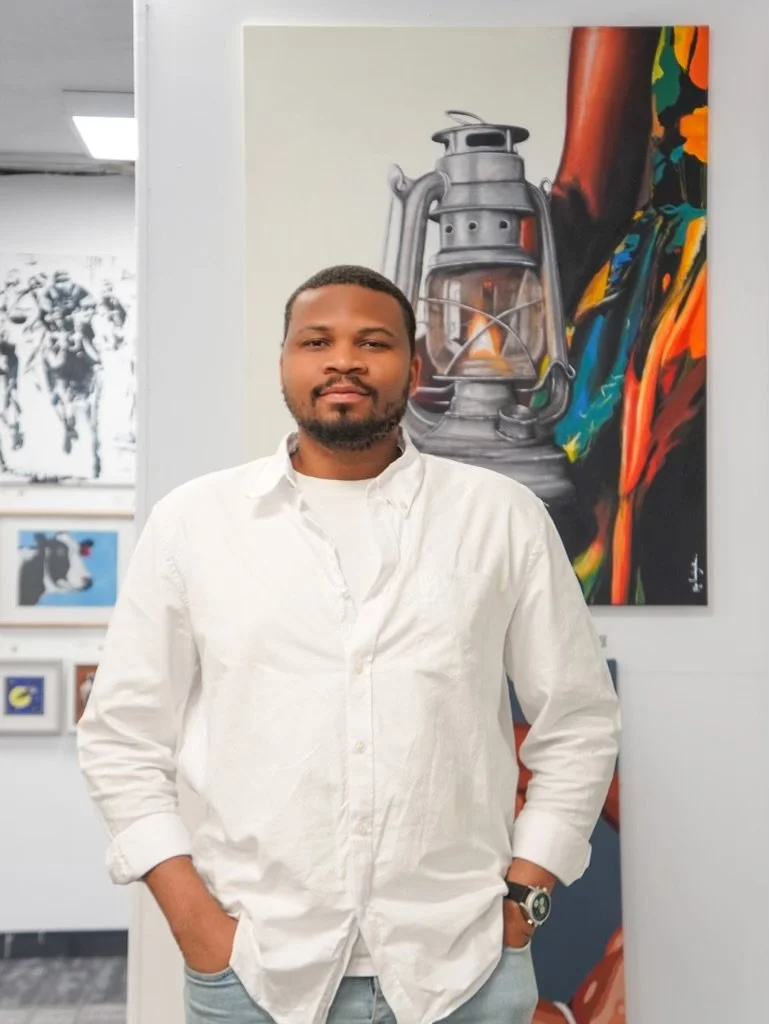
Darlington is a self-taught Nigerian visual artist whose practice is rooted in portraiture, emotional storytelling, and an evolving exploration of identity. Though academically trained in estate management and project management, his commitment to art began in childhood, shaped by solitude and an early fascination with drawing.
Over the years, he has experimented widely across mediums, from charcoal and pastel to oil and acrylic and eventually finding a strong affinity for acrylic as his primary mode of expression. His work, often centered on Black subjects, leans into what he describes as “Afro-realism”: a style that blends technical realism with culturally grounded narratives. Rather than simply depicting faces, Darlington uses portraiture to explore unspoken emotions, hidden scars and the complexity of everyday human experience.
His practice reflects a deep belief in consistency, personal growth, and the quiet but powerful act of showing up both in art and in life.
Can you Tell me About Yourself and how You got into Art?
I started painting when I was a child. I was an only child, so I spent a lot of time by myself, and I found something in painting. I think an uncle of mine drew Jonah and the fish, and that’s where I picked up the interest. Since then, I’ve always looked for ways to develop my craft.
I have a background in estate management for my undergrad, and for my master’s I did project management. But art has always been something I’ve been passionate about, so I never stopped practising.
How would You say Your Art has Changed Over Time?
That’s a very interesting question because each year I find myself practising different things. Initially, when I got into art, I didn’t really know who I wanted to be. I just wanted my work to be more visible than I am. I didn’t want people to know who I was, just that when they saw my art, they recognized it belonged to a particular person, even if they didn’t know my face.
Over time, I started with charcoal, pens, and graphite, then evolved into other mediums. I wanted to test everything. Charcoal, watercolour, gouache, everything available. I think the only thing I didn’t try was pyrography. I practised with oil, acrylic, and pastel. For a long time I worked more with pastel, but now I’ve evolved into acrylic. I’m more based on acrylic now. I just wanted to explore everything and understand what works best for me.
Has the Subject of Your Work Changed Over Time?
Yes. Back then, I focused more on stories. I had a piece called ‘‘Colour Again’’, an indigenous work, though it’s no longer on my social media. Now, I want to explore other things. I want to explore emotions, day-to-day feelings people don’t talk about. Things like migration, moving from one place to another, and those heavy emotions we can’t fully explain but are there for people.
Why do You Mostly Paint Women?
Women are very interesting subjects to paint. For the longest time, I found it boring to paint men. I feel like men don’t have very interesting facial features, to be honest that’s one of the reasons. Women are more emotional, so their expressions carry more weight. It’s easier to pass across any emotion through a woman’s face. There’s always something interesting about a woman’s face, especially since I like to do portraiture most of the time. If I have to choose, I would mostly choose female subjects because there’s always something expressive there.
What Emotions do You Try to Convey in Your Work?
I like to tell stories, especially about hidden emotions. I have a piece, Okola Obinrin, about a woman with tribal marks. I used it to tell the story of how many things we now see as wrong were once accepted. Even though today we wouldn’t agree with it, it was part of a reality at the time.
I also worked on an indigenous mixed media piece where I was trying to talk about the fact that everybody has scars underneath. Beyond good looks and nice facial features, there are always scars, and it takes strength to carry those scars and still live life every day. Most of the time, I’m trying to talk about those hidden scars and the feelings people don’t want to speak about.
What does “Afro-realism” mean to You?
There was a phase in my art where I was looking for the perfect identity. I tried many mediums and styles. At some point, I even thought about avoiding faces because I wanted something different. I didn’t realise that the way I already painted made my work unique. So I came up with Afro realism.
For me, it means that no matter what I paint, I want to achieve realism in my subject. If I’m painting a person, I want it to feel very real. The “Afro” part comes from my background as an African. I mostly paint African concepts, so it’s about combining realism with where I come from.
Would You say Your Work is a form of Cultural Activism or Archiving?
I wouldn’t say it’s cultural activism. I just want to showcase us in any way possible, and the best way I can do that is through my colours. If you notice, my subjects are always brown-skinned. I don’t think I paint light-skinned people— not in a racist way—but I like the colour brown. I like the fact that we are Black people, and I always want to show that we matter and that we feel everything the world feels. I just want to stay with that and represent it in my work.
What is Your Creative Process Like?
I would say it’s a mix of both planned and spontaneous. Sometimes I get ideas while I’m already painting. There’s a painting I’m currently working on, I looked at it halfway and got a new idea, and I switched to something else. Other times, ideas come from experiences or things I’ve gone through. But most times, it’s spontaneous. I could just be thinking about something random, and the idea clicks. I either sketch it down so I don’t forget or start painting immediately if I have a canvas.
Is Consistency Important to You?
Consistency pays off. There were times I took breaks, especially during university, and focused only on commissions. I gave myself many excuses not to return fully. At that time, there was a lot of talk about identity among artists, and I didn’t fully understand what it meant. I thought it had to be one fixed style, and because I couldn’t grasp it, I stepped away for a while.
But when I look at artists doing great work, you can see their track record. Even before they became known, they kept painting and posting. You can see their growth. So I would say consistency outweighs inspiration. You need to keep working, even when it’s not convenient.
On Days when You don’t feel Motivated, what keeps You Going?
I don’t think I’m the best person to answer that because I lost my mom in 2021, and it was very difficult for me to come back to art. For about two years, I wasn’t fully present. I was painting, but I wasn’t putting so much into it. I was just doing commissions, mostly for money. Only time heals. You have to rediscover why you love doing it. I realised it wasn’t just a means to an end, it’s something that’s a part of me. So I took it step by step and gradually came back.