What We Become When We Create: Akunnaya Joseph
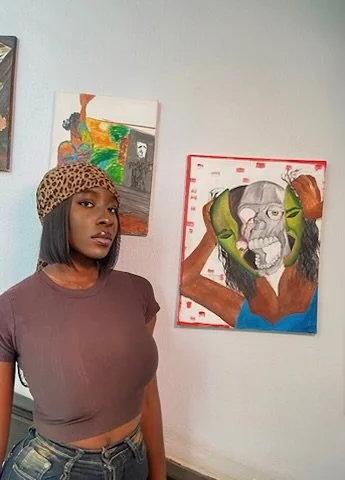
Joseph Akunnaya or “Kunna” is a Nigerian visual artist and economics student whose work explores identity, vulnerability and the process of becoming. Through her signature use of green-toned faces, Kunna creates emotionally charged works that invite viewers to see themselves reflected.
Kunna’s recent series, Fragments of Faith, captures the tension between silence and self-expression, risk and vulnerability, offering a deeply personal yet widely resonant narrative. Through her evolving practice, she continues to carve out a space for honesty and recognition within contemporary Nigerian art.
How did You First Get into Art, and what has Your Journey with it looked Like Over Time?
Art has always been part of my life. Even as a child, I knew it was something I connected to deeply. In primary school, I used to draw for classmates who didn’t know how to do their diagrams and charge them a small fee. Even then, I already saw myself as an artist and believed that was what I would study. But as school became more demanding, I pushed art aside and focused on what felt like “real life.”
When I eventually returned to art years later, it wasn’t easy. I thought I could just pick up where I left off, but I had to relearn technique. Coming back to art meant confronting the fear of starting again. That return changed the way I approached both art and myself.
How Important has Learning and Studying been to Your Growth as an Artist?
Learning has been essential to my journey. When I first came back to painting, I realised that talent alone wasn’t enough. I had to be intentional. I spent time watching tutorials, studying colour theory and observing how other artists approached their work. I learned that things like mixing colours properly or understanding why certain techniques work actually matter.
Before, I would just paint instinctively and hope for the best, but I reached a point where I didn’t even like what I was making. Now, I enjoy my work. I look at my paintings and feel proud because I understand what I’m doing and why. That knowledge gave me confidence and allowed my creativity to grow instead of feeling limited.
Your Work has a Very Distinct Style. How did You Develop Your Visual Language?
Finding my style was one of the most challenging and rewarding parts of my journey. I intentionally set aside time to study other artists, not to imitate them, but to understand what made their work feel authentic. I experimented a lot and allowed myself to struggle, because I knew no one could hand me a style.
The green faces came from that period of experimentation. I noticed that while artists often coloured bodies or backgrounds, very few focused on colouring the face itself. Choosing green wasn’t immediate, it wasn’t even my favourite colour, but I grew into it. Studying different shades of green and understanding colour theory helped me turn it into a core part of my visual language. It became something people could immediately recognize as mine.
When Someone Looks at Your Work, what do You hope they See, Feel, or Reflect on?
I want people to see themselves in my work. My art is about identity, vulnerability and becoming. I love when people say they feel represented in a piece or that it reflects something they’re going through emotionally.
The green faces often confuse people, and I actually enjoy that confusion. It invites questions. To me, green represents growth, sometimes reversed growth, sometimes emotional transition. Every piece is meant to feel like a person with their own personality and emotional depth.
Can You Tell us about the Series Fragments of Faith and what Inspired it?
Fragments of Faith is a series about emotional transformation and self-realisation. The first piece, Unmasked, represents someone who has spent too long pretending to be okay. The skull in the painting isn’t about death, it represents rawness and honesty. The falling eye symbolises awareness: finally seeing clearly and choosing to speak up after years of silence.
The second piece, Leap of Faith, explores the chaos that follows self-expression. When someone who has always been quiet finally speaks up, there’s resistance. The different patterns in the painting represent that chaos, while the rose vines symbolise beauty within it. The tree branch represents risk, vulnerability, and choosing your own path, even when expectations tell you otherwise. Her bare body reflects openness and emotional exposure.
The final piece, The Last Glass, is about choice. It represents deciding what to release and what to hold onto. The wine being poured out symbolises what she’s letting go of, while the smoke represents what she chooses to keep. This piece marks the moment she becomes who shewants to be.
How Much of Yourself do You see in Your Work?
I see a lot of myself in my work. While creating Fragments of Faith, I realised I couldn’t separate myself from the character in the series, I had to move through each stage with her. People often asked if the work was about me, and in many ways, it was.
I’m naturally shy, but my art pushed me to be bold. Talking about my work, explaining it, and standing by its meaning helped me grow into a more confident and expressive person. The process was personal.
How has Being an Artist Changed You Personally?
It gave me a voice I didn’t realise I needed. Through creating, I became more outspoken and comfortable with expressing myself. I no longer feel the need to hide behind silence. As my work evolved, I evolved too. Painting taught me to trust myself and to accept vulnerability. It’s something that shapes who I am.
At this Stage in Your Life, what does Success Look Like to You?
Success, to me, is comfort and freedom. I want to reach a point where I can live by my art without pressure or regret. I want to create because I love it, not because I feel forced to constantly prove myself or document every process. Ultimately, I want people to recognise my work instantly, to see a piece and know it’s mine. I want to push my name and my art forward in a way that feels honest and sustainable, and to look back knowing I stayed true to myself.