Exploring Pan-Africanism and the Makoti with Farooq Mohammed
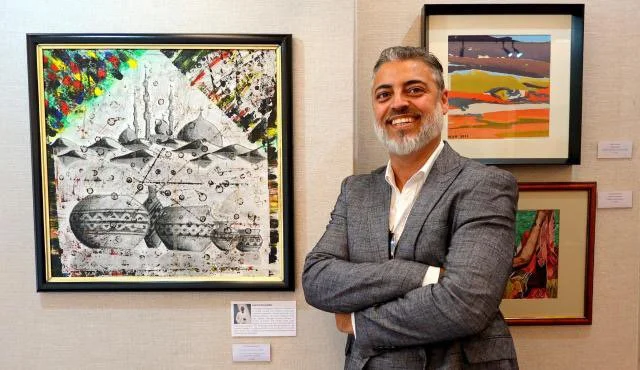
South African artist Farooq Mohammed is a passionate advocate for Pan-Africanism. Growing up in a diverse background, Farooq’s work has raised awareness for unity among Africans, challenging the ongoing issue of racism across parts of Africa.
Let’s Start Getting to know You, who You are, and why You Started.
I'm from Africa. I grew up here, born here, I have a very diverse family background. not to be fled by my skin color. I'm African. Family is like super diverse, and it does the entire continent. So, from my great-grandfather's side, there's Marakaskan, Canadian, Arab, European, and African—it's a whole mixture. It's a fruit salad.
So that's my makeup. And in South Africa, uniquely based on all the things that have been through in this country, from apartheid, you know, racial separations, the inequalities, and all of those things that have been going on. Being in the middle of all that as a multiracial nation, and even myself, with multiple nations making up the person I am, I do not identify as any particular race. I see myself as an African, but purely specifically, I would call myself an Afro-Arabian.
What Inspires Your Work?
What inspires my work is the diversity that I come from. My family background is the message that I want to push and get people to get along, you know. We're living in a time where the world just doesn't want to see eye to eye. We've overcome apartheid over here, but we still have some skirmishes here and there with some people that—how can I say?
There's still a longing for what they would prefer as their good old days, an apartheid, which weren't good old days for the rest of the population, you know. It was practically hell on earth. So it's about overcoming those things. It's about decolonizing in people's minds. It's about stepping out of this zone where people have been placed.
I'm going to give a breakdown. Let's say you step into a library, or just use South Africa as an example, but it happened all over Africa. You step into the library, find different aisles of books and go to the aisle that is Africa. Every single book you go and read is mainly written by Europeans, but why do they know about Africa? So it's like other people start to tell our stories, and it's not by ourselves, and they interpret things in how they want people to see things. So it's not our history; it is his story.
Have You Participated in Exhibitions, Collaborations, etc?
My first exhibition. I was at a place called Calo. So the gallery was owned by a Nigerian guy. Okay. Yeah, in my city. And when I brought one of my first works in and put it up on the wall, it was this one. And it's shot. It shocked everyone. All the people came to come and look at their artwork, and they were amazed by the way everything was Indian. I said, Now, this is just how I operate.
It's a continent on canvas. Because there are no other people really pushing this view and this narrative through unified Africa. When you ask what Pan-Africanism looks like and how things are? We only get put in pieces like, "Oh, this is this country, and that is that one,” but never a full picture of everything together.
And that's why I said, No, I need to be the one who does that. And I got to say, inspired by my own diverse family background. That's really interesting. Working with other artists, we've had group exhibitions, which allow people to get to see different viewpoints and different forms of creativity.
It's good. But I think the one that I'm not just one, actually—every exhibition that I've had, this is one of my best. They've all been amazing. There was one I had at the Nelson Mandela Metropolitan Art Museum. That one was called Through Pan-Africanism, a Look into the Future of Africa. At that point, it was hitting heavy and got a lot of media attention for that as well. I could basically tell the stories of how big people went through it.
That got quite a bit of exposure. I had another one at the tramways and was supported, obviously, by the Department of Arts and Culture on this side, as well as the Nelson Mandela Bay Municipality and the Mandela Development Agency.
What’s the Meaning of Makoti? It's Frequent in Your Work
The meaning of Makoti is basically "the wife." But I also present the Makoti in another cultural context. She is also a thing that we call a “Sangoma.” Now, a sangoma in South Africa is what the Western world would call a witch doctor, but we just see that as a healer. spiritual healer.
So obviously, within the African sense, in our way of doing things. So she is a wife who is also a spiritual healer for the community. So it's a focus on spirituality because women are normally the ones you would find your comfort in and go to when you've got problems, so speaking to the wife. And don't do that either. You know, they're the nurturers; they're the caretakers of society.
So what I'm trying to address through the painting, it's it has multifaceted conversation points. Obviously, around the creative part of it, how it was made, the history about it, all of those things, but the message behind it is also very bold.
It was also created at the same time as a reminder to the men, as we, the guys, that we are to respect, protect, and honor our women and that ties directly into issues such as gender-based violence, femicide, and those types of things, because I also wanted to address those issues. I say, like, you know, by saying, “Let us recognize our women for change.”
Makoti is also there to challenge the Western canon, the Western world, and specifically and directly what the West regards as the most prized possession of this, which is the Mona Lisa, where the question of who versus the Mona Lisa comes up.
And that comparison is extremely powerful because the Makoti hands down far surpasses the Mona Lisa because the Mona Lisa is a single woman, one person, and she's based on Eurocentric beauty standards. Whereas Makoti represents the entire continent. It's a continent on canvas. and it is made in such a way that it must be a painting that captures all the different kinds. So it's like, irrespective of the way from.
Whats Happening in the South African Creative Industry?
Well, I think in South Africa and across the board, the creators space in general, I think for a lot of artists, it's an issue that artists have issues with. But access to certain spaces, representation, getting yourself out there, and selling your work.
So, advice to artists, I would say, is up your business skills, up your marketing skills, network, and push your sophomore. But the very important thing is to be creative. Let your heart speak, put your heart into your work, and find ways of expressing what you want the world to see. You know, put it on whether it carries the beauty around you, or you want to deserve parts of history that's nearly lost to time.
Put your best foot forward. Pride yourself on your work, meaning, don't just do it half-heartedly. Yeah. Put your essence in there because people can see that. They can pick it up from work. If it were just slapped together and lazily put together, there'd be no real passion behind it. And here, sometimes we do create things where we just smack things together because we want that rough aesthetic. But make sure that you intentionally create. Create with intention. And if you're finding yourself in a blank space, just throw a piece of paint on it.
Just start and you end up with a finished product at the end of the day. That would be my advice to artists, but specifically in South Africa, we have a very active art scene over here. There's a lot of space where people can experience, and there are a lot of galleries. There's obviously your initial first market works that can go into the galleries and indirectly to people out there, and then obviously work moves from there. They are considered very valuable to society; they'll obviously end up in the secondary market, where they get resold, so through auctions and it's about. That's it. It's about building that platform for yourself. Don't wait for someone to discover. Discover yourself first. You need to be your biggest discovery and just go for it.